



When it comes to spraying your orchard, field, or vineyard, choosing the right sprayer setup can make a big difference. If you’re stuck between using an ATV sprayer or a 3-point hitch sprayer, you’re not alone.
Each has its place, and depending on your acreage, terrain, and tasks, one might be the better fit for you. Let’s break it down in plain terms, so you can make a smart call.
Another alternative to an ATV sprayer is a drone sprayer. Read the comparison here, in Drone Sprayer vs 3-Point Sprayers: Is High-Tech Always Better?
What’s the Difference?
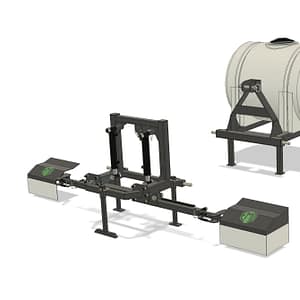
An ATV pesticide sprayer mounts on the back of your four-wheeler or side-by-side. It’s usually a smaller tank, powered by its own pump, and easy to set up. A 3-point sprayer, on the other hand, hooks to the back of a tractor using the 3-point hitch. It runs off the PTO (power take-off) and is built for heavier-duty work.

When an ATV Sprayer Makes Sense
You’ve got a small operation.
If you’re spot-spraying fence lines, food plots, or a few acres of fruit trees, an ATV sprayer is fast and flexible. You can get a compact sprayer into tight rows or weave around obstacles where a big tractor wouldn’t fit. For example, a grower managing a few acres of heirloom apples might use an ATV sprayer to treat specific areas without disturbing delicate root systems.
You’re covering delicate ground.
ATVs are lighter than tractors, so they’re great when the ground is wet, soft, or you want to avoid compaction. After heavy rains, many growers use ATVs to reach spots that would bog down larger equipment.
You need quick setup and lower cost.
ATV sprayers are more affordable and easier to install. This makes them ideal if you’re looking for a small sprayer that’s simple and efficient. No PTO or complex controls… just strap it down and go. This is a great solution if you need to treat a few rows between lunch and your next task.
3-point sprayers are more naturally more expensive than small ATV sprayers, but they are relatively affordable… and maintenance can increase your cost savings. Read How to Prepare a 3-Point Sprayer for Spring in 4 Simple Steps to find out more.
When a 3-Point Sprayer Wins
You need serious volume.
Most 3-point sprayers can hold 100+ gallons, while four-wheeler sprayer units are often around 15–30 gallons. If you’ve got more ground to cover, you’ll spend less time refilling and more time spraying. A farm spraying 20+ acres of orchard weekly, for example, can’t afford constant refills.
You want power and precision.
PTO-driven pumps deliver higher pressure and more consistent flow. This is key for foliar feeding, precise herbicide application, or when you’re running long booms or multiple nozzles. That consistent flow rate is critical for effective canopy penetration and even distribution.
You already have a tractor.
If your tractor sits idle during spray season, a 3-point sprayer turns it into a powerful tool. No need for extra vehicles or equipment. Plus, you get the benefit of using equipment you’re already comfortable operating.
A Quick Comparison:
| Feature | ATV Sprayer | 3-Point Sprayer |
| Tank Size | 15–30 gallons | 50–200+ gallons |
| Power Source | Electric pump | PTO-driven |
| Terrain | Tight, soft, or rough | Wide, open, firm |
| Cost | Lower | Higher |
| Maintain | Simpler | More components |
| Ideal Use | Spot spraying, small plots | Full-field, orchard rows |
Additional Considerations
Weather Sensitivity and Handling:
ATVs offer a big advantage in maneuverability, but they can become unstable on hilly terrain, especially when the tank is full. This affects both safety and spray accuracy.
Meanwhile, 3-point sprayers are better balanced and more stable, even when fully loaded. This can be a lifesaver when working along sloped orchard blocks or bumpy tractor paths.
Maintenance and Longevity:
Both types need routine care, but 3-point sprayers are built with longevity in mind. Thicker tanks, stronger frames, and robust plumbing make them the go-to choice for growers spraying multiple times a week.
One grower who switched from an ATV unit said they were replacing pumps yearly… until they finally upgraded.
Storage and Versatility:
If space is tight, ATV sprayers win again. They’re compact and easy to tuck away in a corner of the barn. But 3-point sprayers come with modular upgrades, like GPS controllers, boomless nozzles, and in-line rinse tanks.
If you plan to scale your operation, that flexibility is worth considering.
Which One’s Right for You?
Go with an ATV sprayer if:
- You farm under 5 acres
- You mostly do spot spraying or fence lines
- You need something simple, portable, and affordable

Choose a 3-point sprayer if:
- You’ve got 5+ acres or a commercial orchard
- You want better pressure and spray control
- You need to spray large areas efficiently

Another consideration for larger orchards is the decision whether to purchase a hydraulic lift trailer or a traditional fixed-bed fruit trailer. Read about the deciding factors in Hydraulic Tilt vs. Fixed-Bed Bin Trailers: Which Is Best for You?
Final Thoughts
At Eastern Manufacturing, we know the best sprayer is the one that fits your land, your equipment, and your goals. If you’re just starting out or managing a small farm, an ATV sprayer might be perfect. But if you’re scaling up or spraying is a core part of your season, a 3-point sprayer is a smart investment.Not sure which one’s best for your setup? Give us a call or visit our page. We’ll help you figure it out… no pressure, just good advice.


0 Comments