


Spend a little time on sprayer forums and you’ll see the same question pop up again and again: “How high should a sprayer boom be set?” Some folks swear by 20 inches, others say 30, and a few admit they just eyeball it.
The truth? The 20-inch rule is a solid starting point for most flat-fan nozzles. But orchards aren’t flat fields. Tree rows, uneven ground, narrow weed strips, and drift concerns mean the “standard” doesn’t always fit. If you’re running a boom height sprayer in an orchard, knowing when to follow the rule—and when to bend it—can save you missed weeds, wasted chemical, and re-sprays.
Does Boom Height Matter
Boom height isn’t just about where the hardware sits; it directly shapes your coverage. Each nozzle is designed to overlap with its neighbors at a certain distance from the ground.
- Too low → patterns don’t meet, leaving streaks of green weeds under trees.
- Too high → fans overlap too much, wasting herbicide and increasing drift.
In orchards, the stakes are higher. You’re working with narrow bands under trees, often in uneven conditions. Small adjustments in sprayer boom height can make the difference between a clean strip and one that needs a second pass.
Boom height is just one of several common mistakes that lead to poor coverage. If you want to see the other issues growers run into, check out 7 3-Point Sprayer Mistakes That Cost You Coverage
The 20-Inch Rule Explained
Most flat-fan nozzles are built to perform best at about 20 inches above the target surface. At this height, the spray fans overlap just enough to provide uniform coverage across the strip. This standard herbicide sprayer boom height works well in broadacre fields.
It’s a rule that works well in broadacre farming, where the ground is level and targets are wide. But in orchards, you’re not spraying an open field—you’re aiming for a defined weed strip under trees, often just 16–20 inches wide. That means nozzle angle, boom height, and strip width all need to line up.
When (and Why) to Break the Rule
The 20-inch rule is a great benchmark, but orchard reality doesn’t always play by benchmarks. There are times when sticking strictly to 20 inches actually hurts your results.
- Uneven orchard floors: If the ground dips and rises, a fixed 20-inch height can leave gaps. Raising the boom slightly may help maintain overlap across rough spots.
- Windy conditions: Drift is a constant battle. Dropping the boom a few inches keeps the spray closer to the target, reducing loss.
- Narrow vs wide weed strips: A 16-inch band under young trees won’t need the same height as a 20-inch or wider band in mature blocks. Sprayer boom height adjustment should match the strip width you’re targeting.
The key takeaway: treat the 20-inch rule as a starting point, not a fixed law. A boom height herbicide sprayer with adjustable booms gives you the flexibility to make these changes quickly in the field.
Running booms too high in windy weather almost guarantees drift. For more drift-control strategies, see 7 Tips to Prevent Overspray
Nozzle Angle & Spray Pattern
Nozzle angle plays a huge role in how high you need to set your boom. Two nozzles with the same flow can behave very differently just based on fan angle. Here’s how nozzle angle affects boom height in practice:
- 80° flat fan nozzle height: Requires more boom height (about 30 inches) to create the proper overlap.
- 110° flat fan nozzle height: Designed for the classic 20-inch setup, giving uniform coverage at lower boom heights.
Air induction herbicide nozzles, which produce larger droplets to reduce drift, may also call for adjustments. Their coarser spray fans can leave gaps if the boom is too low, so raising the air induction nozzle height slightly restores uniform coverage.
A practical example: The ideal boom height for 110 degree flat fan nozzle is about 20 inches. By contrast, the correct boom height for 80 degree flat fan nozzle setups is closer to 30 inches. The wrong combination of angle and height is one of the fastest ways to end up with uneven strips.
When choosing nozzle types for orchards, remember: height, angle, and strip width are a package deal. Adjust one, and you’ll likely need to adjust the others to keep coverage clean.
Nozzle angle plays a huge role in how high you need to set your boom. Choosing the right nozzle ensures your height adjustments match the spray pattern you actually need.
A Quick Overlap Check: Mini-Math for Boom Height
You don’t need engineering software to figure out boom height. A little back-of-the-envelope math (or a quick test with water) is enough.
Here’s the simple formula growers use:
Spray width = 2 × boom height × tan(nozzle angle ÷ 2)
For example:
- At 20″ height with a 110° flat fan, the spray width is about 40″.
- At 30″ height with an 80° flat fan, the spray width is also about 40″.
That’s why nozzle angle and height are inseparable. If you switch nozzles, you need to double-check your boom height to keep the spray fans overlapping at the target strip. That overlap is the key — too little or too much sprayer boom overlap affects both coverage and efficiency.
Pro tip: Lay out a cardboard test strip or use water-sensitive paper. Spray clean water, measure the pattern, and adjust until fans overlap just right. It takes 10 minutes and gives you peace of mind that your setup matches your orchard rows.
Orchard-Specific Adjustments
Orchards put unique demands on sprayers that row-crop guides don’t cover. Narrow strips under trees, uneven soil, and sensitive trunks mean you can’t just follow textbook rules.
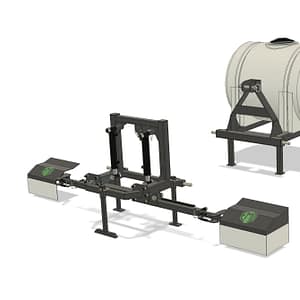
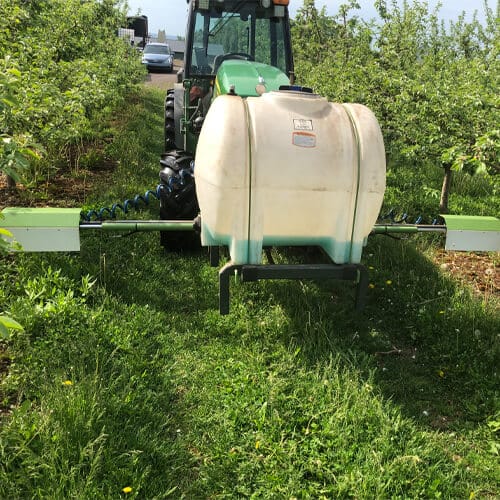
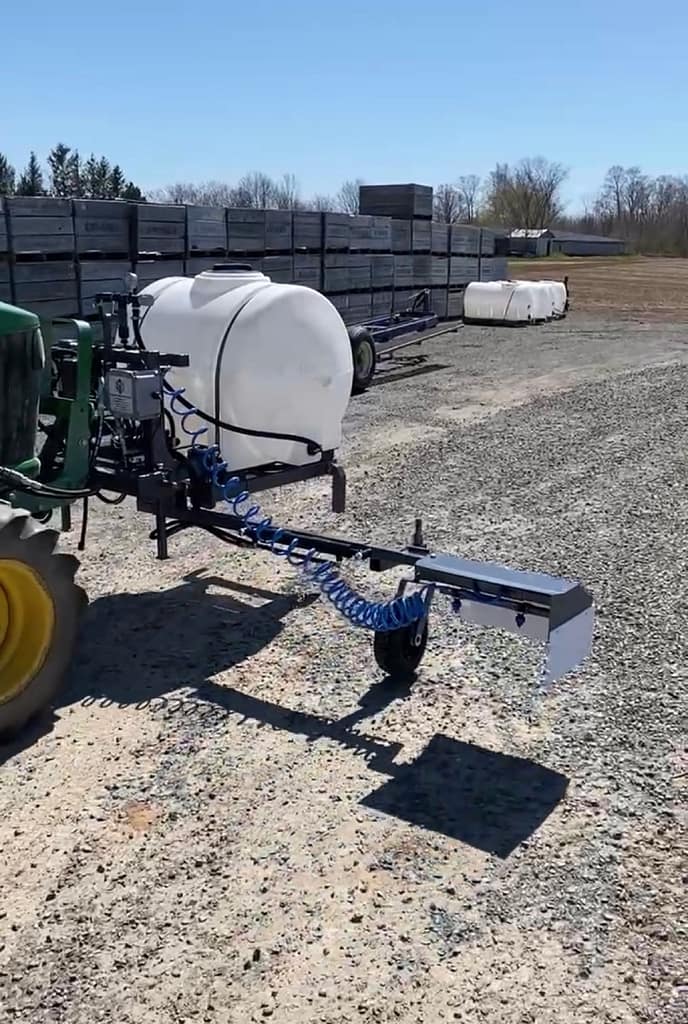
- Adjustable boom widths: Eastern’s orchard boom sprayer models adjust from 8’6″ to 14’6″, letting you match weed strips to different row spacings without drifting into trunks.
- Larger hood options: Running lower to fight drift? Hoods help shield spray from wind and keep it in the strip.
- Dual-nozzle configurations: Useful for wider bands or when you want a coarse + fine spray combo for penetration and drift reduction.
These features let growers break the 20-inch rule confidently, because you can fine-tune boom height, angle, and nozzle type to your exact orchard conditions. That’s the difference between guessing and knowing.

Quick-Check Method for Growers
You don’t need a lab or expensive gadgets to dial in your boom height. Here’s how to adjust boom height for weed strips in the orchard with just water:
- Measure nozzle angle — check your nozzles (e.g., 80°, 110°) so you know their designed spray fan.
- Mark your strip width — lay out flags or use row markers to define the band you want covered.
- Set boom height — start with the 20-inch rule, then raise or lower until spray fans overlap evenly across the strip.
- Run a water test — spray clean water over a dry surface or paper. Look for even coverage without gaps or heavy overlaps.
- Fine-tune in field conditions — check again with actual herbicide, especially on windy days or uneven ground.
This five-step process takes less than 20 minutes and gives you confidence that your boom height sprayer is dialed in before chemicals ever hit the tank.
Boom Height Do’s & Don’ts
- Do calibrate height with your actual nozzle type and angle.
- Do recheck boom height when switching to a new nozzle set.
- Do use hoods or shields when running low in windy orchards.
- Don’t assume the same height works across all rows or strips.
- Don’t ignore row width — a narrow band under young trees needs different settings than wide strips in mature orchards.
- Don’t overlook ground slope — a boom that’s level in the shop may not be level in the orchard.
Height is only part of the equation. Keeping filters and nozzles clean is just as important. Learn more in Step-by-Step 3-Point Sprayer Maintenance
Closing & Call to Action
The “20-inch rule” is a smart starting point, but it’s not the whole story. In orchards, boom height is a moving target shaped by nozzle angle, row spacing, and wind. Get it wrong, and you’ll see streaks of weeds or wasted chemicals. Get it right, and your sprayer becomes a precise, efficient tool.
Every grower has their own tricks — some run low to fight drift, others go higher for wide strips. What’s your go-to method for setting boom height in the orchard? Share your experience — growers learn best from each other.
Eastern’s 3-point boom sprayers make it easy to fine-tune height, angle, and strip width with adjustable booms, hood options, and dual-nozzle setups. Explore our orchard sprayers here and see how the best boom height for orchard sprayer performance can deliver cleaner strips and fewer re-sprays.
FAQ: Boom Height Sprayer
1. Does ground speed affect boom height sprayer performance?
Yes, speed and height work together. If you drive too fast, spray patterns can distort and reduce coverage, especially at lower boom heights. Slower, consistent speeds help the boom height sprayer deliver even overlap.
2. Can uneven orchard terrain affect boom height settings?
Absolutely. A boom that’s set perfectly in the shop can ride unevenly over orchard slopes, leaving gaps or overlaps. It’s best to recheck boom height in the field and adjust for the lowest point of travel.
3. How often should I check the boom height sprayer calibration?
Calibration isn’t one-and-done. For most orchards, a quick water test at the start of each spray season keeps coverage accurate. If you switch nozzles or notice streaks, recalibrate your boom height sprayer immediately.
4. Is it better to run hoods with a boom height sprayer?
Hoods are a smart addition in windy conditions or when running at lower heights. They help shield the spray, reduce drift, and keep coverage focused on the weed strip without overspray onto trunks.
5. What safety precautions should I take when adjusting boom height?
Always turn off the sprayer pump and lower the booms before making adjustments. Wear gloves when handling nozzles or hoods, since residue may remain. A safe setup ensures your boom height sprayer is ready to perform without putting you at risk.


0 Comments