


Drone sprayers sound like the future… compact, remote-controlled machines buzzing over fields, spraying with precision, skipping over muddy ground, and navigating tight spots like a dream.
And yes, they are impressive. But when you dig a little deeper, the high-tech option might not be as simple as it first appears.
Let’s compare drone sprayers with tried-and-true 3-point hitch sprayers to help you decide what’s best for your operation.
| Drone Sprayer | 3-Point Sprayer |
| Very expensive | More affordable |
| Subject to wind drift | Very consistent |
| Complicated to operate or regulated | Easier to operate and maintain |
| Less exposure to chemicals | Larger capacity |
| Very manoeuvrable | Large spray area |
Speed vs. Scale
A drone sprayer can get into tight areas fast. They’re great for spot spraying, especially when using a drone herbicide sprayer for targeted weed control, or reaching plots that are hard to access with a tractor. You don’t need wide turning lanes or perfect weather to fly one. (However, there are weather considerations that we’ll get into later.) On small, irregular fields, drones have the edge.
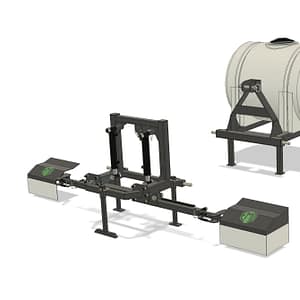
But there’s a catch: drones have limited tank capacity. Most commercial ag drones hold between 3 and 10 gallons. That’s fine for an acre or two, but if you’re treating 20+ acres, you’ll be refilling constantly. A 3-point sprayer, with its 100–300 gallon tank, is built for scale.

Precision and Drift
A drone pesticide sprayer uses downward air pressure from their rotors to push the spray down, which helps with coverage. An automatic sprayer uses a GPS guidance system, which adds precision, and software lets you set up routes in advance.
But wind drift is still a factor, especially at height. In contrast, 3-point sprayers keep the boom close to the crop canopy, reducing off-target drift. For sensitive crops or windy areas, that proximity makes a difference. You don’t want to watch your expensive chemicals drift towards your neighbor’s field (or even worse, their house.)
There are adjustments you can make to be even more precise with your 3-point sprayer. Look at See It, Spray It: Why Front-Mounted Booms Cut Waste in Orchards to find out how.
Cost and Complexity
A drone fruit sprayer isn’t cheap. A quality agricultural drone setup (with batteries, charger, remote, software, and training) can cost $15,000–$30,000 or more. And they often require certification, insurance, and government approval, depending on your region. In Canada, for example, you may need an Advanced Operations certificate and permission for each flight area.
By comparison, a 3-point sprayer is more affordable, easier to maintain, and doesn’t require a pilot’s license. Most farmers can get up and running the same day, with parts that are easy to replace and repair.
With strategic maintenance, you can decrease your 3-point sprayer costs by a lot. Check out The $5 Nozzle That Costs You $500: How Worn Tips Drain Efficiency for an example.

Maintenance and Regulations
Drones need regular firmware updates, battery care, propeller maintenance, and careful storage. You’ll also need to stay on top of flight regulations and pesticide application rules in your province.
And here’s something many new drone users don’t expect: weather risk. Even agricultural drones marketed as water-resistant should never be flown in the rain without caution. The rapidly spinning blades blast droplets in all directions, meaning moisture can still sneak in through vents, corrode electrical components, or interfere with the drone’s stability.
More importantly, flying in less-than-perfect weather requires serious attention. Experienced operators know the signs of trouble (like sudden changes in altitude or rotor noise) and respond quickly to avoid crashes or faulty application.
3-point sprayers? Rinse, drain, grease, and go. Simpler and more familiar… and troubleshooting is almost always easy.
If you’re looking for advice about maintaining your 3-point sprayer, we can help. Read Step-by-Step 3-Point Sprayer Maintenance: Preventing Clogs and Damage to learn about the process.
The Human Factor
For some farmers, drones are an exciting new tool. For others, they’re one more piece of tech to manage in an already packed season. If you’re already comfortable with tractors and PTO equipment, adding a 3-point sprayer fits more easily into your workflow. You probably already have the skills, the equipment, and the muscle memory. No apps or firmware, just get in and drive.

Final Word
Drone sprayers are useful and innovative… but they’re not a magic bullet to all your spraying problems. They shine in niche applications or tight fields, and for special crops. For broad-acre spraying or commercial orchards, a 3-point sprayer still delivers the best combination of capacity, durability, and control. And if you need consistency and reliability, a 3-point sprayer can still deliver better results.
Curious about how drones vs traditional gear will work on your farm? Talk to us. At Eastern Manufacturing, we’ll help you weigh the options and find what fits your farm best.


0 Comments