

Intro:
When harvest hits, everything accelerates.
The clock ticks faster. Crews move quicker. Every bruise, spill, or delay could cost thousands.
That’s why the trailer behind your tractor isn’t just a piece of equipment—it’s a core part of your harvest system.
And yet, many growers are still using flatbeds to haul fruit bins—either out of habit, cost concerns, or because it’s “good enough.” But is it really?
In this post, we’ll pit the purpose-built fruit bin trailer against the multi-use flatbed trailer and ask the question that really matters:
👉 Which one wins at harvest time?
Whether you’re hauling apples in Ontario or berries in Washington, the right trailer setup can make or break your season. Let’s compare them head-to-head and help you decide if it’s time to upgrade.
🟩 Section 1: What Are We Comparing?
Let’s define the two contenders.
🔹 Flatbed Trailer
Usually a general-purpose trailer—often repurposed from equipment hauling, lumber transport, or farm utility work. Farmers may add wooden rails, ratchet straps, or DIY bin stops to adapt it for bin hauling.
It works—but not without trade-offs.
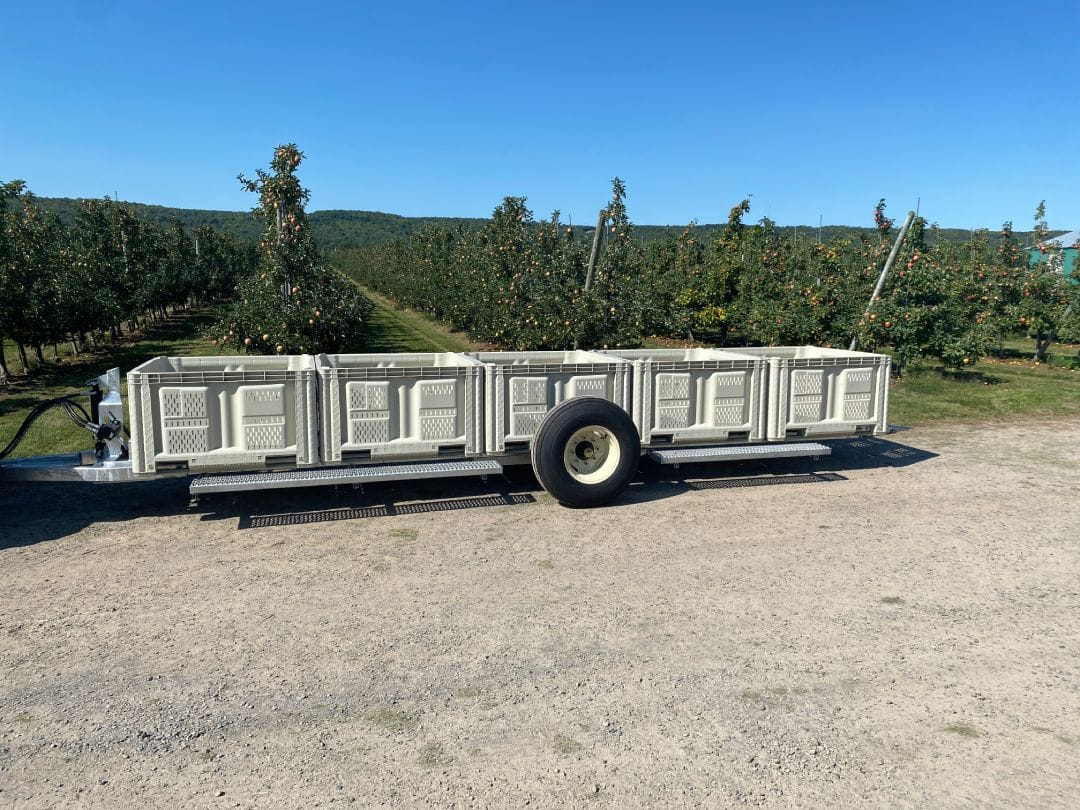
🔸 Fruit Bin Trailer
A trailer specifically designed to carry produce bins safely and efficiently. It includes:
- Built-in bin stops or channels
- Low-profile loading height
- Reinforced frame to absorb field shock
- Bin-spacing to prevent shifting or bruising
These aren’t upgrades—they’re the default design.
Here’s how they stack up at a glance:
| Feature | Fruit Bin Trailer | Flatbed Trailer |
| Bin stability | ✔️ Purpose-built rails or slots | ❌ Must DIY or strap down |
| Loading height | ✔️ Low for hand-loading | ❌ Often higher, requires lifting |
| Protection from movement | ✔️ Built-in stops and spacing | ❌ Bins may slide or bump |
| Terrain handling | ✔️ Built for fields | ⚠️ Designed for roads, not orchards |
| Setup time | ✔️ Instant—just load and go | ❌ Requires straps or modifications |
| Customization options | ✔️ Built to fit your bins & needs | ❌ One-size-fits-most workaround |
Bottom line: The flatbed wasn’t made for this job—you’re just trying to make it work.
ection 2: Speed, Safety & Stability — The Harvest Efficiency Test
Let’s be honest: harvest isn’t the time to be fiddling with straps, climbing onto trailers, or picking bruised fruit out of bins.
This is where the fruit bin trailer pulls ahead—fast.
🚀 Speed: Every Minute Counts
With a flatbed, every bin has to be:
- Lined up perfectly
- Strapped down tightly
- Unstrapped and unloaded at the destination
Multiply that by 20, 30, 50 bins a day—and you’ve lost hours each week in setup alone.
In contrast, a fruit bin trailer is:
- Low to the ground
- Built for fast loading
- Ready to go without modifications
➡️ One of our clients in New York shaved 90 minutes off their daily harvest routine just by switching from flatbeds to bin trailers.
🔐 Safety: Stop the Sliding & Shifting
Flatbeds don’t have natural bin spacing. If you hit a bump or take a turn too fast:
- Bins slide, bump, and bruise fruit
- In some cases, they fall off entirely
You’re left with damaged produce—or worse, dangerous field accidents.
Fruit bin trailers are designed with:
- Built-in bin stops, channels, or locking rails
- Better weight distribution
- Less bounce and sway
You’re not just protecting your harvest—you’re protecting your people.
🛞 Stability: Designed for Dirt, Not Highways
Flatbeds are made for pavement.
But orchards and berry rows? They’re bumpy, muddy, and full of tight turns.
Fruit bin trailers have:
- Lower centers of gravity
- Field-optimized suspension
- Reinforced welds and axles for off-road use
When you’re dragging a trailer across soft soil or tight vineyard rows, you want one built for the job—not borrowed from another task.
Section 3: Labor Impact — Flatbeds Demand More from Your Team
When you’re running a harvest crew, efficiency isn’t just about machines—it’s about people.
And nothing slows a team down like a trailer that wasn’t built for the job.
🧱 More Lifting = More Strain
Flatbeds are usually taller than fruit bin trailers. That means your workers are:
- Lifting bins higher than needed
- Tilting them at awkward angles to slide them into place
- Reaching or stepping up to secure straps
Over the course of a long harvest, this adds up to:
- Fatigue
- Strained backs
- Lost time from minor injuries
A fruit bin trailer is low-profile by design. Workers can load bins:
- At hip height or lower
- Without the need to step up or reach high
- Without wrestling with straps or wedges
The result? A faster, safer, more productive team.
⛓️ Straps Slow Everyone Down
When using a flatbed:
- Each bin often needs two tie-down points
- That’s 4 to 6 bins × 2 straps = 8 to 12 straps
- Multiply that by loading, unloading, and reloading—and you’ve eaten up a huge chunk of your day
Plus, straps:
- Get tangled
- Wear out
- Cause bins to shift if tension loosens
A fruit bin trailer doesn’t need any of this. Just load and go.
👷 Fewer Hands, Less Confusion
Flatbeds often require more hands on deck just to secure bins properly. That means:
- Pulling extra crew from picking or sorting
- More people crowding around the trailer
- A higher risk of miscommunication or mistakes
Fruit bin trailers reduce the chaos:
- Clear lanes for bins
- Built-in stops mean no guessing
- One person can often load solo while others keep working
➡️ If you’re paying your team hourly, every wasted minute is wasted money.
Section 4: Long-Term ROI — Why Flatbeds Cost More Than You Think
At first glance, that old flatbed seems like the budget-friendly option.
But over a full harvest season—or several years—the math tells a very different story.
Let’s break it down.
💸 Hidden Cost #1: Damaged Bins = Replacements
Flatbeds lack proper bin spacing and support, which often leads to:
- Cracked or warped bin corners
- Bins shifting and slamming during transport
- Shortened bin lifespan
With quality fruit bins costing $150–$300+ each, even minor damage adds up.
Lose just 5–10 bins per season, and you’ve just spent $1,000–$3,000 in avoidable costs.
🍓 Hidden Cost #2: Bruised Fruit = Lost Revenue
Fruit damage during transport isn’t always obvious—until your buyers complain.
With flatbeds:
- Bins bump into each other
- Overloaded decks shift on turns
- Fruit settles unevenly due to trailer vibration
Every bruised apple, soft berry, or crushed peach affects your sellable yield.
Even just 2% spoilage across a $50,000 harvest is $1,000 lost.
Multiply that over several harvests, and suddenly your “cheap” trailer is bleeding cash.
⏳ Hidden Cost #3: Wasted Time = Higher Labor Bills
We’ve already talked about how flatbeds slow your crew down.
But what does that look like in numbers?
Let’s say:
- Your crew spends 20 extra minutes per load securing bins on a flatbed
- You run 4 loads per day for 20 harvest days
- Your labor cost averages $25/hour
That’s 1,333 minutes (22.2 hours) × $25 = $555 in extra labor—per harvest.
And that’s being conservative.
Now imagine saving that every season with the right trailer.
🧠 Thought-Provoking ROI Question
What if your fruit bin trailer paid for itself in one season—just from:
- Fewer damaged bins
- Lower labor hours
- Less spoiled produce
Would you still call the flatbed the “cheaper option”?
Probably not.
Section 5: When a Flatbed Might Make Sense
We’re not here to pretend every farmer needs to drop $10K on a new trailer tomorrow. Flatbeds do have their place—but only under very specific conditions.
If any of the following applies to you, a flatbed might still get the job done (for now):
🧺 1. You’re Only Hauling Once or Twice a Season
If you:
- Don’t operate a commercial-scale farm
- Only need to move a few bins per season
- Can spare the extra time and labor
…then sticking with your flatbed may be okay—for now.
Just make sure you’re securing bins properly and watching for long-term damage.
🧵 2. You’ve Custom-Modified Your Flatbed with Stops or Guides
Some growers have retrofitted their flatbeds with:
- Welded bin rails
- Custom bumpers
- Lowered frames or ramps
This makes the trailer safer—but not necessarily faster or easier.
You’re still dealing with higher load height, more straps, and extra labor.
🌱 3. You’re Running a Tiny Operation or Trial Plot
If your entire harvest fits in one or two bins, and you’re just getting started, a flatbed may hold you over during early growth.
But as soon as you scale, your harvest system needs to scale too.
And that’s when the flatbed starts holding you back.
⚠️ But Be Honest With Yourself…
- Are you actually saving money—or just postponing the investment?
- Is your crew working harder than they have to?
- Are you losing quality fruit and not even realizing it?
If any of that rings true… the flatbed might be costing you more than you think.
Section 6: The Verdict — Which One Wins?
When you line them up side by side, it’s clear:
The fruit bin trailer was built for harvest.
The flatbed trailer was built for… pretty much everything else.
| Category | Fruit Bin Trailer | Flatbed |
| Load Speed | ✅ Fast, simple, no straps | ❌ Slower, needs setup |
| Crew Efficiency | ✅ Less lifting, fewer hands | ❌ More labor required |
| Fruit Protection | ✅ Built-in bin spacing | ❌ Higher bruising risk |
| Terrain Handling | ✅ Designed for orchards | ⚠️ Built for pavement |
| Long-Term ROI | ✅ Pays for itself quickly | ❌ Hidden costs accumulate |
| Safety & Stability | ✅ Engineered for bin transport | ❌ Unstable without mods |
🎯 So, Which One Wins?
👉 The fruit bin trailer—by a landslide.
It’s faster, safer, smarter, and more cost-effective over time.
Sure, the flatbed may seem “good enough” in the moment.
But the harvest season doesn’t reward good enough—it rewards efficiency, protection, and planning.
And that’s what the right trailer delivers.
💬 Still Using a Flatbed? Let’s Talk.
At Eastern Manufacturing & Design, we’re not here to shame your current setup.
We’re here to make it better—with trailers designed for real harvest conditions.
If you’re curious how much time and money a custom fruit bin trailer could save you, get in touch here.
📞 Ask us anything. We’ll give you the straight answer—no pressure, no hard sell.
And hey—if you’ve figured out a genius flatbed mod, tell us! We love hearing what growers come up with in the field.
0 Comments