


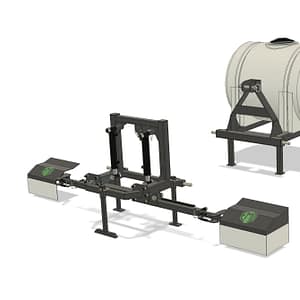

Choosing the right sprayer can make a significant difference in spraying efficiency, chemical usage, and overall farm productivity. When comparing options, many farmers ask the same question: tow-behind sprayer vs 3-point sprayer — which one is better?
Both sprayer types are widely used for applying herbicides, pesticides, and fertilizers. However, they differ in how they attach to tractors, how they perform on different terrain, and how suitable they are for various farm sizes.
In this guide, we’ll break down the key differences between a 3 point sprayer vs pull behind sprayer, helping you determine the best sprayer for your tractor and your specific agricultural needs.
Visit our website for more expert insights.
What Is a Tow-Behind Sprayer?
A tow-behind sprayer, also called a pull-behind sprayer, attaches to the rear of a tractor, ATV, or utility vehicle using a hitch. Instead of being lifted by the tractor’s hydraulic system, the sprayer rolls on its own wheels while being pulled across the field.
Tow-behind sprayers typically feature:
- Large tanks mounted on a wheeled frame
- Boom or boomless spraying systems
- Compatibility with tractors, ATVs, or UTVs
- Higher tank capacity compared to many mounted sprayers
Because they carry their own weight, tow-behind sprayers place less strain on the tractor’s hydraulic system, making them a practical option for smaller tractors. (Note that adding a counterweight for balance helps reduce the strain on a tractor.)
Choosing the right tractor size is an important consideration when deciding on a sprayer. Take a look at What is the Best Tractor Size for a 3-Point Sprayer? 4 Essential Factors to Consider to learn more.
Tow Behind Sprayer Benefits
Tow-behind sprayers offer several advantages depending on your farm size and equipment setup.
Larger Tank Capacity
One of the main tow behind sprayer benefits is the ability to carry larger tanks. Since the sprayer rides on its own wheels, it can hold more liquid without relying on the tractor’s lifting capacity.
This allows operators to:
- Cover more acreage per refill
- Reduce downtime during spraying operations
- Improve efficiency on large properties
Reduced Tractor Strain
Because the sprayer is not lifted by the tractor, tow-behind systems place less stress on:
- tractor hydraulics
- rear lift arms
- hitch systems
This can be particularly helpful when using compact or mid-sized tractors.
Flexible Equipment Compatibility
Tow-behind sprayers can often be used with different types of vehicles, including:
- tractors
- ATVs
- utility vehicles
This flexibility makes them useful for farms that rely on multiple types of equipment.

What Is a 3-Point Sprayer?
A 3-point sprayer mounts directly to the tractor’s three-point hitch system. The sprayer becomes part of the tractor, allowing the operator to lift and lower it using hydraulic controls.
These sprayers are commonly powered by the tractor’s PTO system, which drives the pump responsible for spraying.
A typical 3-point sprayer includes:
- a mounted tank
- a PTO-driven pump
- boom or boomless spraying systems
- adjustable nozzles for accurate coverage
Because they mount directly to the tractor, these sprayers offer strong control and precision.
3 Point Sprayer Benefits
There are several important 3 point sprayer benefits that make them popular among farmers and orchard managers.
Improved Maneuverability
Since the sprayer is mounted directly to the tractor, it moves with the tractor’s frame. This allows for:
- tighter turning
- easier navigation around obstacles
- better control in orchards or narrow rows
For operations with trees, fences, or uneven terrain, this improved maneuverability can make spraying much easier.
Better Spray Precision
3-point sprayers often provide more precise application because the operator has direct control over boom height and positioning.
This helps maintain:
- consistent spray coverage
- reduced overlap
- more efficient chemical use
Precision is especially important when applying herbicides in orchards or vineyards.
Faster Setup and Transport
Mounted sprayers are typically easier to transport because they move with the tractor rather than trailing behind it.
This simplifies:
- field transitions
- transport between properties
- storage and parking
For many farmers, this convenience is a major advantage.

Tow-Behind Sprayer vs 3-Point Sprayer: Key Differences
When comparing tow-behind sprayer vs 3-point sprayer, several factors can influence which option works best for your farm.
| Feature | Tow-Behind Sprayer | 3-Point Sprayer |
| Attachment | Pulled behind tractor | Mounted to tractor hitch |
| Tank Capacity | Typically larger | Moderate capacity |
| Tractor Strain | Lower | Higher due to mounted weight |
| Maneuverability | Wider turning radius | Better maneuverability |
| Setup | Hitch connection | Hydraulic mounting |
| Precision | Moderate | Higher control and accuracy |
Each system has strengths depending on your field conditions and equipment.
Which Sprayer Is the Best Sprayer for Your Tractor?
The best sprayer for tractor use depends on several factors including field size, terrain, and tractor capability.
Choose a Tow-Behind Sprayer If:
A tow-behind sprayer may be the better option if:
- you have large fields
- you want longer spraying time between refills
- your tractor has limited lift capacity
- you prefer equipment compatible with multiple vehicles
These sprayers are often ideal for pastures, large properties, and open farmland.
Choose a 3-Point Sprayer If:
A 3-point sprayer may be a better fit if:
- you need precise spray control
- your farm has obstacles or narrow rows
- you want easier transport between areas
- your tractor has sufficient lift capacity
These sprayers are commonly used in orchards, vineyards, and specialty crops.

For more benefits of a front-mounted sprayer, read See It, Spray It: Why Front-Mounted Booms Cut Waste in Orchards.
Farm Size Considerations
Another important factor when comparing a 3 point sprayer vs pull behind sprayer is acreage.
Small Farms (Under 10 Acres)
3-point sprayers are often ideal because they provide excellent control and maneuverability.
Medium Farms (10–40 Acres)
Both sprayer types can work well depending on tank capacity and terrain.
Large Farms (40+ Acres)
Tow-behind sprayers may be more efficient due to their larger tank size and reduced refill frequency.

Final Thoughts
Both sprayer types provide effective solutions for applying herbicides, pesticides, and fertilizers. Understanding the strengths of each system will help you choose the equipment that best matches your farm’s needs.
When comparing tow-behind sprayer vs 3-point sprayer, the right choice ultimately depends on your tractor size, field layout, and spraying requirements.
For large open areas, tow-behind sprayers offer excellent capacity and flexibility. For operations that require precision and maneuverability, a 3-point sprayer may be the better option.
At Eastern we know that choosing the right equipment ensures efficient spraying, reduced chemical waste, and improved crop management. Looking for the best equipment? Talk to us today.
Another thing that helps with efficient spraying and reduced chemical waste is taking care of your nozzles. Read The $5 Nozzle That Costs You $500: How Worn Tips Drain Efficiency.
FAQs
What is the difference between a tow-behind sprayer and a 3-point sprayer?
The main difference is how the sprayer attaches to the tractor. Tow-behind sprayers are pulled behind the tractor on wheels, while 3-point sprayers mount directly to the tractor’s hitch system.
Which sprayer type is easier to maneuver?
A 3-point sprayer is generally easier to maneuver because it moves with the tractor rather than trailing behind it.
Do tow-behind sprayers require a larger tractor?
Not necessarily. Since the sprayer carries its own weight, tow-behind systems often work well with smaller tractors.
Which sprayer is better for orchards?
3-point sprayers are often better for orchards because they allow for tighter turning and more precise spray control.
Which sprayer works best for large fields?
Tow-behind sprayers are typically better for large fields because they can carry larger tanks and cover more acreage between refills.


0 Comments